Tuesday, June 4, 2013
Elementary Differential Equations and Boundary Value Problems 10e
Elementary Differential Equations and Boundary Value Problems 10th Edition PDF Download Ebook. William E. Boyce and Richard C. DiPrima focus on the theory and practical applications of Differential Equations to engineering and the sciences. Emphasis is placed on the methods of solution, analysis, and approximation.
Use of technology, illustrations, and problem sets help readers develop an intuitive understanding of the material. Historical footnotes trace the development of the discipline and identify outstanding individual contributions. This book builds the foundation for anyone who needs to learn differential equations and then progress to more advanced studies.
The linear and nonlinear equations (first order and higher order) are treated in separate chapters. Most students studying differential equations are preparing for careers in the physical or life sciences. In developing models, this text guides the student carefully through the underlying physical principles leading to the relevant mathematics.
Emphasis on the importance of common sense, intuition, and “back-of-the-envelope” checks to help the student ask: “Does my answer make sense?” Many of the examples and exercises ask the student to anticipate and interpret the physical content of the solution.
Reference in later courses provides students in science and engineering with a useful reference for their later coursework. A special version of this visualization software is included FREE with every book. It is mapped specifically to the organization of this text. First order differential equations (linear and nonlinear) are now discussed in a single chapter, Chapter 2.
Second order and higher order linear equations are discussed in one chapter, Chapter 3. The introductory discussion for linear systems (Chapter 4) has been streamlined to reach the computational aspects of the theory as quickly as possible. Chapter 11 has been shortened to focus solely on linear two-point boundary value problems.
New exercises have been added to increase problem variety. A section of short projects has been added to the end of each chapter to expand students’ mathematical horizons. A review of core material appears at the ends of Chapters 2, 3, and 4, and requires students to apply solution techniques developed in the chapter.
More details about this book...
or
Download Elementary Differential Equations and Boundary Value Problems PDF Ebook :
Calculus for Business, Economics, Life Sciences and Social Sciences 12e
Calculus for Business, Economics, Life Sciences and Social Sciences 12th Edition PDF Download Ebook. Raymond A. Barnett, Michael R. Ziegler and Karl E. Byleen help readers help themselves to excel. The content is organized into two parts: (1) A Library of Elementary Functions (Chapters 1–2) and (2) Calculus (Chapters 3–9).
The book’s overall approach, refined by the authors’ experience with large sections of college freshmen, addresses the challenges of teaching and learning when readers’ prerequisite knowledge varies greatly. Reader-friendly features such as Matched Problems, Explore & Discuss questions, and Conceptual Insights, together with the motivating and ample applications, make this text a popular choice for today’s students and instructors.
The examples are annotated and the problem-solving steps are clearly identified. This gives students extra assistance in solving the problem. Think Boxes (dashed boxes) are used to enclose steps that are usually performed mentally. A “Matched Problem” follows each example. This gives the student an opportunity to reinforce and test his/her understanding of the concept presented in the preceding example.
Answers to these problems are located in the Answers Section, located at the end of the text. Large variety of up-to-date applications use simplified versions of real models. It illustrates the relevance of mathematics to the real world and gives students opportunities to create and interpret mathematical models. Explore-Discuss boxes are integrated in every section.
Author encourages students to think about a relationship or process before a result is stated, or investigate additional consequences of a development in the text, so that they can better participate in the learning process and discussion- both in and out of class. Chapter Review exercises and answers are included, as well as suggested group activities and key terms. Optional graphing utility examples and exercises are clearly identified by an icon.
More details about this book...
or
Download Calculus for Business, Economics, Life Sciences and Social Sciences PDF Ebook :
Statistics for Business and Economics 12th Edition, Anderson
This summary is not available. Please
click here to view the post.
Monday, June 3, 2013
Discrete and Computational Geometry by Satyan Devadoss
Discrete and Computational Geometry PDF Download Ebook. Satyan L. Devadoss and Joseph O'Rourke cover traditional topics such as convex hulls, triangulations, and Voronoi diagrams, as well as more recent subjects like pseudotriangulations, curve reconstruction, and locked chains.
Discrete geometry is a relatively new development in pure mathematics, while computational geometry is an emerging area in applications-driven computer science. Their intermingling has yielded exciting advances in recent years, yet what has been lacking until now is an undergraduate textbook that bridges the gap between the two. This text offers a comprehensive yet accessible introduction to this cutting-edge frontier of mathematics and computer science.
It also touches on more advanced material, including Dehn invariants, associahedra, quasigeodesics, Morse theory, and the recent resolution of the Poincaré conjecture. Connections to real-world applications are made throughout, and algorithms are presented independently of any programming language. This richly illustrated textbook also features numerous exercises and unsolved problems.
The book offers essential introduction to discrete and computational geometry. It covers traditional topics as well as new and advanced material, features numerous full-color illustrations, exercises, and unsolved problems. It is suitable for sophomores in mathematics, computer science, engineering, or physics, rigorous but accessible.
This guide meets an urgent need for an undergraduate text bridging the theoretical sides and the applied sides of the field. It is an excellent choice as a textbook for an undergraduate course in discrete and computational geometry! The presented material should be accessible for most mathematics or computer science majors in their second or third year in college. The book also is a valuable resource for graduate students and researchers.
More details about this book...
or
Download Discrete and Computational Geometry PDF Ebook :
Combinatorial Commutative Algebra, Ezra Miller and Sturmfels
Combinatorial Commutative Algebra PDF Download Ebook. Ezra Miller and Bernd Sturmfels provide a self-contained introduction to the subject, with an emphasis on combinatorial techniques for multigraded polynomial rings, semigroup algebras, and determinantal rings.
The eighteen chapters cover a broad spectrum of topics, ranging from homological invariants of monomial ideals and their polyhedral resolutions, to hands-on tools for studying algebraic varieties with group actions, such as toric varieties, flag varieties, quiver loci, and Hilbert schemes. Over 100 figures, 250 exercises, and pointers to the literature make this book appealing to both graduate students and researchers.
Each chapter begins with an overview and ends with Notes on references and pointers to the literature. Theorems are, for the most part, attributed only in the Notes. When an exercise is based on a specific source, that source is credited in the Notes. For the few exercises used in the proofs of theorems in the main body of the text, solutions to the non routine ones are referenced in the Notes. The References list the pages on which each source is cited.
The mathematical notation throughout the book is kept as consistent as possible, making the glossary of notation particularly handy, although some of our standard symbols occasionally moonlight for brief periods in nonstandard ways, when we run out of letters. The exposition mainly concerns combinatorially defined ideals and their quotients, with a focus on numerical invariants and resolutions, especially under gradings more refined than the standard integer grading.
More details about this book...
or
Download Combinatorial Commutative Algebra PDF Ebook :
Discrete Mathematics for Computer Science, Gary Haggard
Discrete Mathematics for Computer Science PDF Download Ebook. Gary Haggard, John Schlipf and Sue Whitesides offer accessible text that emphasizes the fundamentals of discrete mathematics and its advanced topics. This text shows how to express precise ideas in clear mathematical language. An increasing number of computer scientists from diverse areas are using discrete mathematical structures to explain concepts and problems.
Students discover the importance of discrete mathematics in describing computer science structures and problem solving. They also learn how mastering discrete mathematics will help them develop important reasoning skills that will continue to be useful throughout their careers.
Gary Haggard is Professor of Computer Science at Bucknell University. His research in data structures focuses on the implementation of effective algorithms for computing invariants for large combinatorial structures such as graphs. Dr. Haggard¿s current work is directed towards finding chromatic polynomials of large graphs.
John Schlipf is a Professor of Computer Science in the Department of Electrical and Computer Engineering and Computer Science at the University of Cincinnati. His research interests include logic programming and deductive databases, algorithms for satisfiability, computability and complexity, formal verification, and model theory.
Sue Whitesides is Professor of Computer Science at McGill University. She holds a Ph.D. from University of Wisconsin and a Masters from Stanford University. Her research interests lie within combinatorial mathematics and theoretical computer science.
More details about this book...
or
Download Discrete Mathematics for Computer Science PDF Ebook :
Sunday, June 2, 2013
Discrete Mathematics with Graph Theory 3rd Edition, Goodaire
Discrete Mathematics with Graph Theory 3rd Edition PDF Download Ebook. Edgar G. Goodaire and Michael M. Parmenter make the principles and practices of discrete mathematics as stimulating as possible while presenting comprehensive, rigorous coverage. Examples and exercises integrated throughout each chapter serve to pique reader interest and bring clarity to even the most complex concepts.
Above all, the book is designed to engage today's readers in the interesting, applicable facets of modern mathematics. More than 200 worked examples and problems, as well as over 2500 exercises are included. Full solutions are provided in the back of the book. More than 150 Pauses—short questions inserted at strategic points—are included. Full solutions to Pauses are included at the end of each section.
The most common (negative) criticism of our first edition was the short treatment of logic and the absence of truth tables. This problem has been remedied with Chapter 1 (previously Chapter 0) completely rewritten and expanded significantly to include new sections on truth tables, the algebra of propositions, and logical arguments.
The text now includes more than enough material for instructors who wish to include a substantial unit on formal logic, while continuing to permit a shorter treatment dealing exclusively with the major points and jargon of proofs in mathematics. The second most common complaint—and every student's favorite—was the shortage of answers in the back of the book. In fact, the first edition contained over 500 solved problem. For the second edition, however, this number has been increased to over 800.
Graph theory is the subject of Chapters 9 through 15, and again we find that there is more material here than can be successfully treated in thirty-three lectures. Chapter 13 (Depth-First Search and Applications) can also be omitted without difficulty. In fact, most of the last half of this book is self-contained and can be treated to whatever extent the instructor may desire.
More details about this book...
or
Download Discrete Mathematics with Graph Theory PDF Ebook :
Saturday, June 1, 2013
Discrete and Combinatorial Mathematics 5th Edition, Grimaldi
Discrete and Combinatorial Mathematics: An Applied Introduction 5th Edition PDF Download Ebook. Ralph P. Grimaldi continues to improve on the features that have made it the market leader. The text offers a flexible organization, enabling instructors to adapt the book to their particular courses. The book is both complete and careful, and it continues to maintain its emphasis on algorithms and applications.
Excellent exercise sets allow students to perfect skills as they practice. This new edition continues to feature numerous computer science applications-making it the ideal text for preparing students for advanced study. This text has an enhanced mathematical approach, with carefully thought out examples, including many examples with computer sciences applications.
Historical reviews and biographies bring a human element to their assignments. Chapter summaries allow students to review what they have learned. There is expanded treatment of discrete probability in Chapter 3 with new material on cryptology, private-key cryptosystems in Chapter 14; public-key RSA cryptosystems in Chapter 16.
Interest in graphs and their applications has grown exponentially in the past two decades, largely due to the usefulness of graphs as models for computation and optimizations. This book targets the need for a fresh approach to the theory. Students will be able to develop the techniques of research used in theoretical areas of CS such as algorithms.
More details about this book...
or
Download Discrete and Combinatorial Mathematics PDF Ebook :
Discrete Mathematical Structures 6th Edition, Kolman
Discrete Mathematical Structures 6th Edition PDF Download Ebook. Bernard Kolman, Robert Busby and Sharon C. Ross have woven in a thread of coding in all its aspects, efficiency, effectiveness, and security. Two new sections, Other Mathematical Structures and Public Key Cryptology are the major components of this thread, but smaller related insertions begin in Chapter 1.
The number of exercises for this edition has been increased by more than 25%. Whatever changes we have made, our objective has remained the same as in the first four editions: to present the basic notions of discrete mathematics and some of its applications in a clear and concise manner that will be understandable to the student.
Chapters 1 through 10 each end with a student experiment. These provide opportunities for discovery and exploration, or a more in-depth look at topics discussed in the text. They are designed as extended-time, out-of-class experiences and are suitable for group work. Each experiment requires significantly more writing than section exercises do. Some additional experiments are to be found in Appendix B. Content, prerequisites, and goals for each experiment are given in the Instructor's Solutions Manual.
Chapter 1 contains material that is fundamental to the course. This includes sets, subsets, and their operations; sequences; properties of the integers, including base n representations; matrices; and mathematical structures. A goal of this chapter is to help students develop skills in identifying patterns on many levels. Chapter 2 covers logic and related material, including methods of proof and mathematical induction.
Although the discussion of proof is based on this chapter, the commentary on proofs continues throughout the book. Chapter 3, on counting, deals with permutations, combinations, the pigeonhole principle, elements of probability, and recurrence relations.
Chapter 4 presents basic types and properties of relations, along with their representation as directed graphs. Connections with matrices and other data structures are also explored in this chapter. Chapter 5 deals with the notion of a function and gives important examples of functions, including functions of special interest in computer science.
An introduction to the growth of functions is developed. Chapter 6 covers partially ordered sets, including lattices and Boolean algebras. A symbolic version for finding a Boolean function for a Boolean expression joins the pictorial Kamaugh method. Chapter 7 introduces directed and undirected trees along with applications of these ideas. Elementary graph theory with applications to transport networks and matching problems is the focus of Chapter 8.
In Chapter 9 we return to mathematical structures and present the basic ideas of semigroups, groups, rings, and fields. By building on work in previous chapters, only a few new concepts are needed. Chapter 10 is devoted to finite-state machines. It complements and makes effective use of ideas developed in previous chapters.
Chapter 11 finishes our discussion of coding for error detecting and correction and for security purposes. Appendix A discusses algorithms and pseudocode. The simplified pseudocode presented here is used in some text examples and exercises; these may be omitted without loss of continuity. Appendix B gives some additional experiments dealing with extensions or previews of topics in various parts of the course.
More details about this book...
or
Download Discrete Mathematical Structures PDF Ebook :
Discrete Mathematics 5th Edition by Ross and Wright
Discrete Mathematics 5th Edition PDF Download Ebook. Kenneth A. Ross and Charles R. Wright presents a sound mathematical treatment that increases smoothly in sophistication. The book presents utility-grade discrete math tools so that any reader can understand them, use them, and move on to more advanced mathematical topics. Market: A handy reference for computer scientists.
Authors have aimed to make our account simple enough that these students can learn it and complete enough that they won't have to learn it again. The most visible changes in this edition are the 274 new supplementary exercises and the new chapters on probability and on algebraic structures. The supplementary exercises, which have complete anstheyrs in the back of the book, ask more than 700 separate questions.
Together with the many end-of-section exercises and the examples throughout the text, these exercises let students practice using the material they are studying. The presentation starts with an intuitive approach that becomes more and more rigorous as the students' appreciation for proofs and their skill at building them increase.
Authors illustrate the way mathematicians attack problems, and they show the potheyr of an abstract approach. The math majors have been introduced to the mathematics culture, and the computer science students have been equipped to look at their subject from both mathematical and operational perspectives.
Every effort has been made to avoid duplicating the content of mainstream computer science courses, but they are aware that most of our readers will be coming in contact with some of the same material in their other classes, and they have tried to provide them with a clear, mathematical view of it. An example of our approach can be seen first in Chapter 4, where they give a careful account of while loops.
Authors base our discussion of mathematical induction on these loops, and also, in Chapter 4 and subsequently, show how to use them to design and verify a number of algorithms. They have deliberately stopped short of looking at implementation details for our algorithms, but they have provided most of them with time complexity analyses. They hope in this way to develop in the reader the habit of automatically considering the running time of any algorithm. In, addition, our analyses illustrate the use of some of the basic tools they have been developing for estimating efficiency.
More details about this book...
or
Download Discrete Mathematics PDF Ebook :
Thursday, May 30, 2013
Discrete Mathematics: Elementary and Beyond by LovĂ¡sz
Discrete Mathematics: Elementary and Beyond PDF Download Ebook. L. LovĂ¡sz, J. PelikĂ¡n and K. Vesztergombi offer excellent introduction to a lot of problems of discrete mathematics. It discusses a number of selected results and methods, mostly from areas of combinatorics and graph theory, and it uses proofs and problem solving to help students understand the solutions to problems.
Numerous examples, figures, and exercises are spread throughout the book. Discrete mathematics is quickly becoming one of the most important areas of mathematical research, with applications to cryptography, linear programming, coding theory and the theory of computing. This book is aimed at undergraduate mathematics and computer science students interested in developing a feeling for what mathematics is all about, where mathematics can be helpful, and what kinds of questions mathematicians work on.
The authors discuss a number of selected results and methods of discrete mathematics, mostly from the areas of combinatorics and graph theory, with a little number theory, probability, and combinatorial geometry. Wherever possible, the authors use proofs and problem solving to help students understand the solutions to problems.
In addition, there are numerous examples, figures, and exercises spread throughout the book. The authors develop most topics to the extent that they can describe the discrete mathematics behind an important application of mathematics.
More details about this book...
or
Download Discrete Mathematics: Elementary and Beyond PDF Ebook :
Discrete Mathematics by Kevin Ferland
Discrete Mathematics PDF Download Ebook. Kevin Ferland combines a balance of theory and applications with mathematical rigor and an accessible writing style. The author uses a range of examples to teach core concepts, while corresponding exercises allow students to apply what they learn.
Throughout the text, engaging anecdotes and topics of interest inform as well as motivate learners. The text is ideal for one- or two-semester courses and for students who are typically mathematics, mathematics education, or computer science majors. Part I teaches student how to write proofs; Part II focuses on computation and problem solving. The second half of the book may also be suitable for introductory courses in combinatorics and graph theory.
CL MATHSpace encompasses the interactive online products and services integrated with Houghton Mifflin mathematics programs. CL MATHSpace content--including PowerPoint slides and practice tests--can be accessed at any time through text-specific Student and Instructor Websites. Unique among similar texts, Part I features proofs as its central topic--taking the approach that basic set theory is the best area in which to first learn how to write proofs.
Extensive applications cover a broad range of topics and appeal to diverse student interests, while the depth and quantity of exercises meet instructor needs. Challenging problems are highlighted throughout the text to provide flexible assignment options. Hundreds of worked-out examples and highly appealing presentations capture and maintain student interest.
More details about this book...
or
Download Discrete Mathematics by Kevin Ferland PDF Ebook :
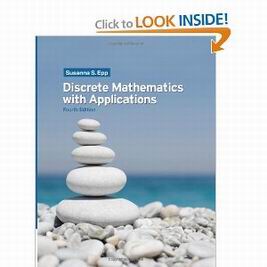
Discrete Mathematics with Applications 4th Edition, Epp
Discrete Mathematics with Applications 4th Edition PDF Download Ebook. Susanna S. Epp provides a clear introduction to discrete mathematics. Renowned for her lucid, accessible prose, Epp explains complex, abstract concepts with clarity and precision. This book presents not only the major themes of discrete mathematics, but also the reasoning that underlies mathematical thought. Students develop the ability to think abstractly as they study the ideas of logic and proof. While learning about such concepts as logic circuits and computer addition, algorithm analysis, recursive thinking, computability, automata, cryptography, and combinatorics, students discover that the ideas of discrete mathematics underlie and are essential to the science and technology of the computer age. Overall, Epp's emphasis on reasoning provides students with a strong foundation for computer science and upper-level mathematics courses. Author addresses inherent difficulties in understanding logic and language with very concrete and easy-to-conceptualize examples, an approach that helps students with a variety of background better comprehend basic mathematical reasoning, and enables them to construct sound mathematical arguments. There are around 2500 exercises providing ample practice for students, with numerous applied problems covering an impressive array of applications. There are over 500 worked examples in problem-solution format. Proof solutions are intuitively developed in two steps, a discussion on how to approach the proof and a summary of the solution, to allow students the choice or quicker or more deliberate instruction depending on how well they understand the problem.
This book has flexible organization, allowing instructors the ability to mix core and optional topics easily to suit a wide variety of discrete math course syllabi and topic focus. Features, definitions, theorems, and exercise types are clearly marked and easily navigable, making the book an excellent reference that students will want to keep and continually refer back to in their later courses.
A new Chapter 1 introduces students to some of the precise language that is a foundation for much mathematical thought, and is intended as a warm-up before addressing topics in more depth later on. New margin notes are provided to provide better context-sensitive help highlighting issues of particular importance.
More details about this book...
or
Download Discrete Mathematics with Applications PDF Ebook :
Tuesday, May 28, 2013
Discrete Mathematics and Its Applications 7th Edition
Discrete Mathematics and Its Applications 7th Edition PDF Download Ebook. Kenneth Rosen offers complete topics, intended for one- or two-term introductory discrete mathematics courses taken by students from a wide variety of majors, including computer science, mathematics, and engineering.
This renowned best-selling text, which has been used at over 500 institutions around the world, gives a focused introduction to the primary themes in a discrete mathematics course and demonstrates the relevance and practicality of discrete mathematics to a wide a wide variety of real-world applications from computer science to data networking, to psychology, to chemistry, to engineering, to linguistics, to biology, to business, and to many other important fields.
Author offers an improved organization of topics making the book a more effective teaching tool. Substantial enhancements to the material devoted to logic, algorithms, number theory, and graph theory make this book more flexible and comprehensive. Numerous changes in the seventh edition have been designed to help students more easily learn the material. Additional explanations and examples have been added to clarify material where students often have difficulty.
New exercises, both routine and challenging, have been added. Highly relevant applications, including many related to the Internet, to computer science, and to mathematical biology, have been added. The companion website has benefited from extensive development activity and now provides tools students can use to master key concepts and explore the world of discrete mathematics, and many new tools under development will be released in the year following publication of this book.
Students must understand mathematical reasoning in order to read, comprehend, and construct mathematical arguments. This text starts with a discussion of mathematical logic, which serves as the foundation for the subsequent discussions of methods of proof. Both the science and the art of constructing proofs are addressed. The technique of mathematical induction is stressed through many different types of examples of such proofs and a careful explanation of why mathematical induction is a valid proof technique.
This text has been carefully designed for flexible use. The dependence of chapters on previous material has been minimized. Each chapter is divided into sections of approximately the same length, and each section is divided into subsections that form natural blocks of material for teaching. Instructors can easily pace their lectures using these blocks.
The writing style in this book is direct and pragmatic. Precise mathematical language is used without excessive formalism and abstraction. Care has been taken to balance the mix of notation and words in mathematical statements. Over 800 examples are used to illustrate concepts, relate different topics, and introduce applications. In most examples, a question is first posed, then its solution is presented with the appropriate amount of detail.
More details about this book...
or
Download Discrete Mathematics and Its Applications PDF Ebook :
Elementary Statistics: A Step By Step Approach 8e, Bluman
Elementary Statistics: A Step By Step Approach 8th Edition PDF Download Ebook. Allan Bluman provides a significant leap forward in terms of online course management with McGraw-Hill’s new homework platform, Connect Statistics – Hosted by ALEKS.
Statistic instructors served as digital contributors to choose the problems that will be available, authoring each algorithm and providing stepped out solutions that go into great detail and are focused on areas where students commonly make mistakes. From there, the ALEKS Corporation reviewed each algorithm to ensure accuracy. The result is an online homework platform that provides superior content and feedback, allowing students to effectively learn the material being taught.
It is for introductory statistics courses with a basic algebra prerequisite. The book is non-theoretical, explaining concepts intuitively and teaching problem solving through worked examples and step-by-step instructions. In recent editions, author has placed more emphasis on conceptual understanding and understanding results, along with increased focus on Excel, MINITAB, and the TI-83 Plus and TI-84 Plus graphing calculators; computing technologies commonly used in such courses.
The 300 new exercises most based on actual data were added to the book. Students are motivated by seeing statistics applied to the real world, as they learn to work with "messy" numbers (rather than data contrived for easy computation). Additionally, many exercises were rewritten asking students to interpret the results they just found. These questions help students focus on what a result means rather than simply finding a result.
A new feature, “Applying the Concepts” was added to each section and appears prior to each exercise set. The purpose of the feature is to reinforce the concepts. They give the student an opportunity to think about the concepts and apply them to hypothetical examples and scenarios similar to those found in newspapers, magazines, on news programs, etc. Most contain open-ended questions that require critical thinking and interpretation. “Applying the Concepts” can be used for homework assignments or used as topics for in-class discussion or group work.
"Technology Step by Step" sections show how to solve basic problems using Minitab software, the TI-83 Plus and TI-84Plus graphing calculators, or Excel. Students can concentrate on ideas rather than software syntax; they learn to translate easily from problem-solving procedures to on-screen commands.
More details about this book...
or
Download Elementary Statistics: A Step By Step Approach PDF Ebook :
Thinking Mathematically 5th Edition, Robert F. Blitzer
Thinking Mathematically 5th Edition PDF Download Ebook. Robert F. Blitzer continues to raise the bar with his engaging applications developed to motivate readers from diverse majors and backgrounds. This book draws from the author’s unique background in art, psychology, and math to present math in the context of real-world applications.
The author understands the needs of nervous readers and provides helpful tools in every chapter to help them master the material. Voice balloons are strategically placed throughout the book, showing what an instructor would say when leading a student through a problem. Study tips, chapter review grids, Chapter Tests, and abundant exercises provide ample review and practice.
Students in this course are not math majors, and they may never take a subsequent math course, so they are often nervous about taking the class. Blitzer understands those students’ needs and provides helpful tools in every chapter to help them master the material. Voice balloons appear right when students need them, showing what an instructor would say when leading a student through the problem. Study tips, chapter review grids, Chapter Tests, and abundant exercises provide ample review and practice.
The variety of topics and flexibility of sequence make this text appropriate for a one- or two-term course in liberal arts mathematics, quantitative reasoning, finite mathematics, mathematics for education majors, and courses specifically designed to meet state-mandated requirements in mathematics. Blitzer’s hallmark applications keep students motivated and pull from timely real-world events and data.
Chapter openers and section openers present compelling applications, helping students to realize that mathematics is everywhere. Each vignette poses a question and explores how the section’s subject can be applied to answer the question. These scenarios are then revisited in the chapter or section. Interesting applications from all disciplines, supported by up-to-date, real-world data, are included in every section. Students see how mathematics can be used to solve real problems.
The latest applications and real-world data are compiled from hundreds of books, magazines, newspapers, almanacs, and online sites. For the Fifth Edition, 265 worked-out examples and application exercises are based on new data. Exercises are organized into six categories for instructor flexibility: Practice Exercises, Application Exercises, Writing in Mathematics, Technology Exercises, Critical Thinking Exercises, and Group Activity Exercises.
More details about this book...
or
Download Thinking Mathematically PDF Ebook :
Monday, May 27, 2013
Technical Analysis of Stock Trends 10th Edition, Edwards
Technical Analysis of Stock Trends 10th Edition PDF Download Ebook. Robert D. Edwards, John Magee and W.H.C. Bassetti still tower over the discipline of technical analysis like a mighty redwood. Originally published in 1948 and now in its Tenth Edition, this book remains the original and most important work on this topic.
The book contains more than dry chart patterns, it passes down accumulated experience and wisdom from Dow to Schabacker, to Edwards, and to Magee, and has been modernized by W.H.C. Bassetti. Bassetti, a client, friend, and student of John Magee, one of the original authors, has converted the material on the craft of manual charting with TEKNIPLAT chart paper to modern computer software methods. In actuality, none of Magee’s concepts have proven invalid and some of his work predated modern concepts such as beta and volatility.
In addition, Magee described a trend-following procedure that is so simple and so elegant that Bassetti has adapted it to enable the general investor to use it to replace the cranky Dow Theory. This procedure, called the Basing Points procedure, is extensively described in the new Tenth Edition along with new material on powerful moving average systems and Leverage Space Portfolio Model generously contributed by the formidable analyst, Ralph Vince., author of Handbook of Portfolio Mathematics.
So much has changed since the first edition, yet so much has remained the same. Everyone wants to know how to play the game. The foundational work of the discipline of technical analysis, this book gives you more than a technical formula for trading and investing, it gives you the knowledge and wisdom to craft long-term success.
More details about this book...
or
Download Technical Analysis of Stock Trends PDF Ebook :
Technical Mathematics with Calculus 6th Edition, Calter
Technical Mathematics with Calculus 6th Edition PDF Download Ebook. Paul A. Calter and Michael A. Calter continue to provide real-world, technical applications that promote intuitive reader learning. Numerous fully worked examples and boxed and numbered formulas give students the essential practice they need to learn mathematics.
Computer projects are given when appropriate, including BASIC, spreadsheets, computer algebra systems, and computer-assisted drafting. The graphing calculator has been fully integrated and calculator screens are given to introduce computations. Everything the technical student may need is included, with the emphasis always on clarity and practical applications.
This textbook has been in constant use since 1980, and this edition represents the first major revision of this text since the second edition. It was time to select, make hard choices of material, polish, refine, and fill in where needed. Much has been rewritten to be even cleaner and clearer, new features have been introduced, and some peripheral topics have been removed.
This edition contains a new chapter on statistics as well as a new section on straight line graphing. Many of the exercises have been revised to ensure they are scaffolded in difficulty level from easy to challenging. This is the feature most mentioned by reviewers, and has obvious benefits to students and instructors.
The technical applications provide motivation for the student and examples for an instructor who may not have a technical background. Additionally, an Index to Applications aids in finding applications in a particular field, such as electrical technology. Estimation shows a student whether an answer is reasonable or not reasonable. They show common pitfalls for both student and instructor and are flagged and boxed, wherever appropriate. Formulas used in the text are boxed and numbered, and listed in the Appendix as the Summary of Facts and Formulas.
Every chapter concludes with a section of optional enrichment activities. Many students are attracted to the magic and history of mathematics and welcome a guided introduction into this world. These writing questions aim to test and expand a student's knowledge of the material and perhaps explore areas outside of those covered in class while team projects foster "collaborative learning."
More details about this book...
or
Download Technical Mathematics with Calculus PDF Ebook :
Friday, May 24, 2013
Doing Bayesian Data Analysis: A Tutorial with R and BUGS
Doing Bayesian Data Analysis: A Tutorial with R and BUGS PDF Download Ebook. John K. Kruschke provides an accessible approach to Bayesian data analysis, as material is explained clearly with concrete examples. The book begins with the basics, including essential concepts of probability and random sampling, and gradually progresses to advanced hierarchical modeling methods for realistic data.
The text delivers comprehensive coverage of all scenarios addressed by non-Bayesian textbooks--t-tests, analysis of variance (ANOVA) and comparisons in ANOVA, multiple regression, and chi-square (contingency table analysis). There is an explosion of interest in Bayesian statistics, primarily because recently created computational methods have finally made Bayesian analysis obtainable to a wide audience.
From the very first chapter, the engaging writing style will get readers excited about this topic, a comment one can rarely make about statistical books. Clearly a master teacher, the author, John Kruschke, uses plain language to explain complex ideas and concepts. A comprehensive website is associated with the book and provides program codes, examples, data, and solutions to the exercises. If the book is used to teach a statistics course, this set of materials will be necessary and helpful for students as they go through the materials in the book step by step.
This book is intended for first year graduate students or advanced undergraduates. It provides a bridge between undergraduate training and modern Bayesian methods for data analysis, which is becoming the accepted research standard. Prerequisite is knowledge of algebra and basic calculus. Free software now includes programs in JAGS, which runs on Macintosh, Linux, and Windows.
It is accessible, including the basics of essential concepts of probability and random sampling with examples with R programming language and BUGS software. Comprehensive coverage of all scenarios is addressed by non-bayesian textbooks- t-tests, analysis of variance (ANOVA) and comparisons in ANOVA, multiple regression, and chi-square (contingency table analysis).
This text also offers coverage of experiment planning, R and BUGS computer programming code on website. Exercises have explicit purposes and guidelines for accomplishment. The text has the potential to change the methodological toolbox of a new generation of social scientists, bringing them up to a level of computation, modeling, and analysis that they might not have thought to be within their grasp. Where past approaches to teaching statistics to those in psychology and economics have not lead to widespread insight, this tutorial approach might.
More details about this book...
or
Download Doing Bayesian Data Analysis PDF Ebook :
Thursday, May 23, 2013
Linear Algebra with Applications 5th Edition, Bretscher
Linear Algebra with Applications 5th Edition PDF Download Ebook. Otto Bretscher emphasizes linear transformations as a unifying theme. This elegant textbook combines a user-friendly presentation with straightforward, lucid language to clarify and organize the many techniques and applications of linear algebra. Exercises and examples make up the heart of the text, with abstract exposition kept to a minimum.
Extensive problem sets keep students involved in the material, while genuine applications for a broad range of sciences prepares them for the methods and models of contemporary scientists. In addition, the wealth and variety of exercise sets enable instructors to design a course to best suit the goals and needs of their students. This revision reflects careful review and appropriate changes to the wording of each idea, while preserving the content structure of the previous edition.
Linear transformations are introduced early in the text to make the discussion of matrix operations more meaningful and easier to navigate. Visualization and geometrical interpretation are emphasized extensively throughout the text. An abundance of problems, exercises, and applications help students assess their understanding and master the material.
Abstract concepts are introduced gradually throughout the text. Major ideas are carefully developed at various levels of generality before the student is introduced to abstract vector spaces. Discrete and continuous dynamical systems are used as a motivation for eigenvectors and as a unifying theme thereafter. Fifty to sixty True/False questions conclude every chapter, testing conceptual understanding and encouraging students to read the text.
Historical problems from ancient Chinese, Indian, Arabic, and early European sources add diversity to the selection of exercises. Rotations, reflections, projections, and shears are used throughout to illustrate new ideas. Multiple perspectives on the kernel of a matrix are presented, with a stronger emphasis on the relations among the columns.
Commutative diagrams enhance students' conceptual understanding of the matrix of a linear transformation. These diagrams enable students to visualize the relations between linear transformations. A more conceptual approach to the QR factorization is presented, in terms of a change-of-basis.
More details about this book...
or
Download Linear Algebra with Applications PDF Ebook :
Subscribe to:
Posts (Atom)